The science and joy of eating a banana
"A taste of honey, tasting much sweeter than wine..."
A Taste of Honey, The Beatles 1962
What are cucumbers made of?
They are 96% water, and where does that come from?
Rain.
They are Nature's perfect package of water, fibre and energy.
Fruit and especially bananas, the point of this article, are similar. Some have very high water content, as well as sugar content. This sugar, fructose, is a natural sugar, which gives us energy. The fibre in the fruit that comes with it too prevents the fructose going into our system too quickly and giving an insulin spike. It is perfectly designed for our bodies. Or our bodies are perfectly designed for fruit, whichever way you want to look at it.
However, if we look at modern methods of food processing, such as sugar production, we see it's an extremely long and unnatural process. It reminds me of large scale drug production.
 |
| Drug Production on a Grand Scale - Massecuite = molasses |
Most importantly, all fibre is removed during the process. This means we're having pure sugar, sans fibre, going into our systems when we consume it, which produces an insulin spike. The body goes into overdrive and if it can't use the sugar as fuel immediately, it will store it as fat. This is all ok if you don't eat much sugar.
However, these days avoiding sugar is extremely difficult. For example, which has more sugar in it? A bottle of 500ml 'full fat' Coke, or a 500ml glass of freshly squeezed orange juice? The answer is...exactly the same. Up to 50g of sugar (or 12 sugar cubes) in each.
And because orange juice is squeezed, the fibre is removed. As a result it is as bad for you as Coke! Yet it is marketed as being healthy. Another example is the ironically named Innocent smoothies (or smoothies in general). They can have large percentages of sugar in them, and again, without that fibre in them.
Check the label of your favourite foods. You may be surprised (as I was) to discover the sugar content can be significant.
Breakfast cereal? 50% sugar per serving! Would you eat 6 sugar cubes for breakfast? That's what we consider normal now.
Low fat foods are made low fat by simply removing the fat. But, then they taste horrible. So sugar is injected, making them more unhealthy!
The large majority of food is processed and inserted with sugar. Which was also processed.
This may go some way to explaining our 'obesity epidemic'. Maybe people are just eating too much sugar, especially hidden sugar, they didn't realise was there. For most people this is just normality. Watch this video of a couple who cut out sugar completely for four weeks.... and see if you recognise the man afterwards. And this with zero exercise.
We focus on fat content with foods, but the main concern is with sugar content, because that stuff is rocket fuel. This means that fat in food is nowhere near as dangerous as has been made out. So the good news is that you can go back to drinking whole fat milk and enjoying butter. Did you know that whole fat milk is delicious? After drinking semi-skimmed for 20 years I had forgotten. All a load of wasted time.
So my new diet is NO SUGAR! I can eat anything else I want, but the daily sugar intake must be 15g or less. This will mean that, in theory, the body will look to use fat for fuel and will lose weight as a result. To ensure this works, I'm going to need to maintain a low-ish carbohydrate intake of around 120g a day. But just stopping sugar intake is a great start.
So what alternatives are there to sugar? Fruit is great. It contains fructose, but the fibre offsets that to allow us to eat it without worry.
You'll stop eating sugary foods as you lose the taste for it. One good example is chocolate. As an experiment I gave my daughter some chocolate. She's a total chocaholic and her hand moved that chocolate to her mouth like lightning. Then she tasted it. I had given her 85% cocoa chocolate. Of course she hated it. 'Ugggghhh!!'
But that is what chocolate truly tastes like. Milk chocolate is loaded with well, milk, and sugar. This makes chocolate, which is horrible, because it is a drug, and we hate the taste of all drugs, to be palatable to us.
"A spoonful of sugar, helps the medicine go down..."
That's why we drink spirits with mixers. After years we can work ourselves up to drinking a spirit 'neat'. It's all down to an acquired taste. We can even build that up with dark chocolate if we really wanted to. Tea is another example. Who drinks tea black? No, milk and sugar sweeten the horrible taste.
But if you want really hard drugs, all you have to do is look at coffee. Why, in a recession, do the coffee shops keep on opening? Because there are plenty of coffee-drinkers who need that hit, and have acquired a taste to the extent that they will down a double-espresso! Was their first coffee ever like that? Or did their first one contain milk and sugar?
So, we've looked into the biology, let's look into the maths and chemistry of banana eating.
What's the optimum and tastiest way to eat a banana? There are two parts to a banana. Once it is peeled, there is the outer dry surface and then inner, gooey, centre.
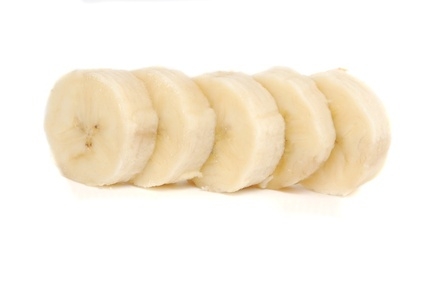
In my research, I have found it best to thinly slice a banana. This means that when the slices are popped into the mouth, the gooey central part is a large area of what is being tasted, meaning the dry part is barely tasted at all.
 |
| Leave vertical to maximise contact with the air |
But what is the optimum size for these slices? Mathematics has the answers. What we want to achieve is a slice as thick as possible without losing the gooey taste. What's the thickest we can slice?
First of all, model the banana as a cylinder. To ensure a nice taste, we want to area of the circles on the end of each slice to be greater than or equal to the area of the dry circumference part. If this was stretched out this would be a rectangle, with an area of slice length multiplied by the circumference of the banana.
The formula for this is calculated by using the number of radii that, if were used as a measure, would fit around a circle. For any circle, it is always 6.28, or 2pi radii.
The area of a circle is calculated by use of radius sized squares. In a circle, you can fit four of these squares around a circle, but this is too large. It's a case of putting a square peg into a round hole. In fact, you can fit exactly 3.14 of these size squares into a circle, or pi of them.
So we want the area of the circles to be larger than the area of the rectangle, i.e.
Cancelling the 2s and pi's and r's, we find that
Result. To put that in English, we want the slice length to be less than the radius of the banana.
So do we simply slice and eat one at a time? Or do we slice the whole banana first, then eat the slices? Why does it matter? Chemistry has the answers.
When we slice the banana, the amylase enzyme in the banana reacts with oxygen in the air, which breaks down the starch into sugar, making it gooier and tastier as a result. If we just slice and eat, there isn't time for the chemical reaction to take place and there's almost no point in slicing the banana at all. This is why it is preferable to slice the banana, give it time to react with the oxygen in the air, and taste more banana-like.
So the perfect recipe is to eat natural non-processed fruits and vegetables, high in water content and with high fibre. If eating a banana, slice it with thickness of the radius of the banana (or half the diameter!) and allow it a minute to react with the air.
You'll find the same equation holds true with other fruits, such as an apple. If you eat an apple from your hand, each bite is mostly the outer skin, which has a dry, dull taste. If you slice it up, the area of the inner, juicy parts increases and improves the taste immensely. Try it with oranges too - amazing.
Besides, would you eat a cucumber without slicing it?